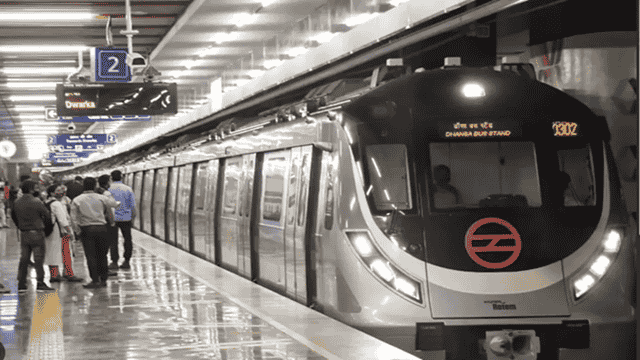


The Delhi government is planning a major expansion of the metro network under Phase V (b). Chief Minister Rekha Gupta is expected to announce a 97 km expansion with seven new corridors and 65 stations. The aim is to improve metro access in outer areas of the city and make travel easier for people.
Expansion Plan and Key Routes
According to reports, the new metro lines will connect Central Secretariat to Kishangarh, Najafgarh to Nangloi, and extend the route from Samaypur Badli to Narela. This will help bring far north areas into the metro network.
Other planned corridors include Kirti Nagar to Palam, Jor Bagh to Mithapur, Shastri Park to Mayur Vihar Phase III, and Keshavpuram to Rohini Sector 34. These routes will improve metro connectivity across West, South, and East Delhi.
The project is still in the planning stage. It aims to improve connectivity in areas like Najafgarh, Narela, Badarpur, Kondli, Geeta Colony, and Gandhi Nagar market. The Chief Minister said this expansion will connect crowded areas to the metro network and provide faster, safer, and more convenient travel.
Cost and Project Details
The total cost of the project is estimated at ₹48,204.56 crore. Out of this, the first six corridors will cost around ₹43,335 crore, while the seventh corridor will cost ₹4,869.56 crore. The Chief Minister said this expansion will improve last-mile connectivity, reduce travel time, and support cleaner transport. It will also help in balanced and inclusive urban development across Delhi.
Corridor Details and Timeline
The first corridor, Dhansa Bus Stand to Nangloi, will be taken up first. This 11.9 km route will be fully elevated and will have nine stations. It will connect areas like Naresh Park Extension, Ranhola, Bakkarwala, Baprola, Dichaon Kalan, and Najafgarh Extension. Interchange will be available at Nangloi (Green Line) and Dhansa Bus Stand (Grey Line).
The second corridor, Central Secretariat to Kishangarh, will cover 15.9 km. Around 13.7 km will be underground. It will have 10 stations, including nine underground and one elevated. It will connect areas like New Moti Bagh GPRA colonies, RK Puram Sectors 1 and 7, Jawaharlal Nehru University, and the Prime Ministers’ Museum. Interchange points will include Central Secretariat (Violet, Yellow, and Magenta lines), Moti Bagh (Pink Line), RK Puram (Magenta Line), and Kishangarh (Golden Line).
The third corridor, Samaypur Badli to Narela, will extend Line-2 by 12.9 km. It will be fully elevated with eight stations. Interchange will be available at Siraspur (Yellow Line) and Narela DDA Sports Complex (Red Line).
The fourth corridor, Kirti Nagar to Palam, will cover 9.9 km. It will include 8.4 km underground and 1.6 km elevated sections. There will be six stations, including five underground and one elevated. Interchange will be available at Mayapuri (Pink Line) and Palam (Magenta Line).
The fifth corridor, Jor Bagh to Mithapur, will be about 17 km long with both underground and elevated sections. It will have 12 stations, including seven underground. Interchange points will include Jor Bagh (Yellow Line), Lajpat Nagar (Violet and Pink lines), NSIC Okhla (Magenta Line), Jasola Apollo (Violet Line), and Madanpur Khadar (Golden Line extension).
The sixth corridor, Shastri Park to Mayur Vihar Phase III, will be 13.2 km long. Around 9 km will be underground. It will have eight stations. Interchange will be available at Shastri Park (Red Line), Nirman Vihar (Blue Line), and Trilokpuri (Pink Line).
The seventh corridor, Keshavpuram to Rohini Sector 34, will be 16.3 km long and fully elevated. It will have 12 stations. Interchange will be available at Keshavpuram (Red Line), North Pitampura (Pink Line), and Rohini Sector 34 (Red Line).
The Chief Minister said that four corridors will be treated as priority projects and are expected to be completed by 2029. The remaining three corridors will be developed later in phases. She has also asked the Delhi Metro Rail Corporation to prepare and submit updated project reports for both priority and non-priority corridors.